Ranked portfolio

Projects

Detailed systems I’ve built across healthcare AI, embedded firmware, robotics, hardware validation, full-stack platforms, and electrical design.

I like projects where software has to survive contact with the real world: messy clinical data, physical hardware, sensors, deployment constraints, customer workflows, and debugging. These projects show how I think through systems from architecture to implementation, validation, and real-world use.

Healthcare ML
Embedded firmware
Robotics systems
Hardware validation
Full-stack platforms
Electrical design

Featured systems

Flagship work

The first four projects are the clearest expression of how I build: product-minded software, rigorous validation, robotics integration, and hardware that works in the field.

1

CareFuse

Healthcare AI / Clinical ML / Full-stack systems

Co-founder & ML Lead Software Engineer

An end-to-end healthcare AI platform designed to predict orthopedic treatment outcomes and help compare total knee replacement against conservative treatment.

Why it mattered

Orthopedic decisions are expensive, high-stakes, and often made without patient-specific outcome prediction. CareFuse was built to help patients, physicians, and payers understand likely outcomes more clearly before committing to major treatment decisions.

Problem

Patients with knee osteoarthritis often face uncertainty when choosing between surgery and conservative care. Physicians and payers need evidence that is personalized, interpretable, and clinically useful, not just generic population-level statistics.

What I built

Built the end-to-end ML and software platform spanning clinical data processing, patient-level feature engineering, dual-arm outcome modeling, model validation, explainability, backend APIs, deployment, and workflow design. Developed a framework to estimate likely outcomes for surgery versus conservative treatment using demographic, clinical, and patient-reported outcomes data.

Technical depth

Implemented feature pipelines, nested cross-validation, Bayesian hyperparameter optimization, calibration workflows, SHAP-based explanation reports, model evaluation, and fairness/clinical utility checks. Built the backend using FastAPI and Docker, with APIs designed for healthcare workflow integration.

Impact

Supported a pilot and customer discovery with physicians, administrators, and a major Brazilian healthcare payer/provider serving 10M+ covered lives. Demonstrated my ability to build production-oriented AI systems in a regulated, messy, high-stakes domain.

Skills demonstrated

Machine learning, backend engineering, clinical data pipelines, calibration, explainability, product strategy, customer discovery, API design, deployment, stakeholder communication.

Python scikit-learn XGBoost SHAP FastAPI Docker AWS Clinical ML Calibration Feature Engineering
2

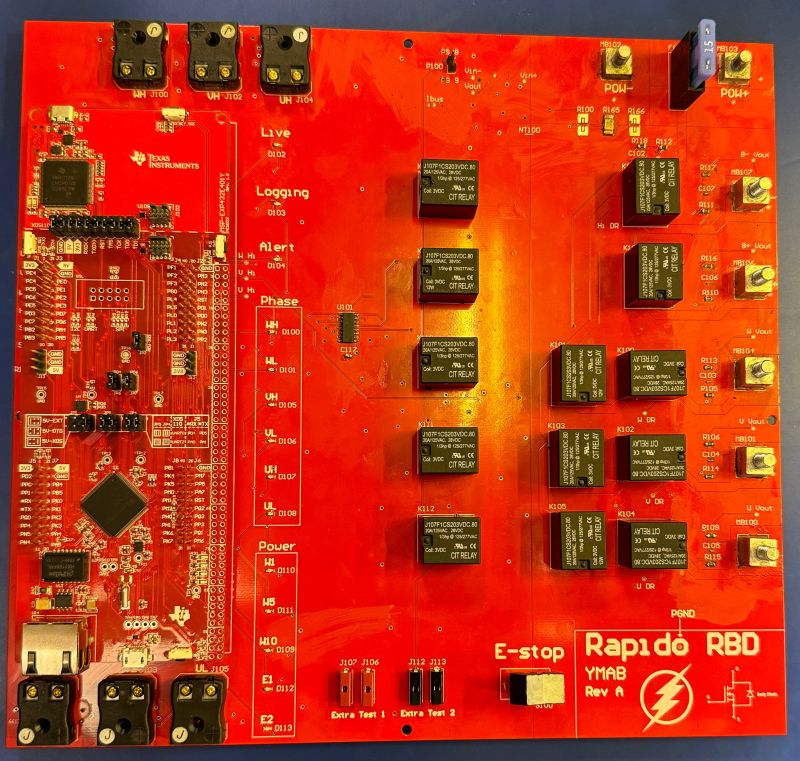
Automated Motor Controller Validation System

Embedded systems / Hardware test automation / Electrical design

Electrical Engineering Intern, Stanley Black & Decker

An automated embedded test fixture for validating DeWalt motor controllers used in power tools.

Why it mattered

The existing motor controller thermal validation process was manual, repetitive, slow, and difficult to standardize. The goal was to automate a multi-hour validation workflow while improving repeatability and data consistency.

Problem

Manual testing required engineers to repeatedly monitor the test setup and collect data over long thermal cycles. This created wasted engineering time and made it harder to standardize validation across units.

What I built

Designed test circuitry and a custom Altium PCB integrating relay drivers, thermocouple sensing, high-current power paths, and microcontroller control. Wrote embedded C firmware on a TI MSP432 microcontroller to control the test sequence, capture temperature data, monitor sensors, and automate the validation workflow.

Technical depth

Worked across relay control, high-current power paths, thermocouple measurement, I2C communication, embedded state sequencing, hardware bring-up, root-cause analysis, and thermal validation. Debugged real hardware issues using an oscilloscope and firmware-level validation.

Impact

Reduced manual motor-controller validation time by 4+ hours and improved repeatability, reliability, and data consistency. This project is one of the clearest examples of my ability to build complete hardware-software systems.

Skills demonstrated

Embedded C, PCB design, power electronics, sensor integration, hardware debugging, validation testing, firmware development, system-level thinking.

Embedded C TI MSP432 ARM Cortex-M Altium I2C Thermocouples Relays Power Electronics Oscilloscope Hardware Bring-up
3

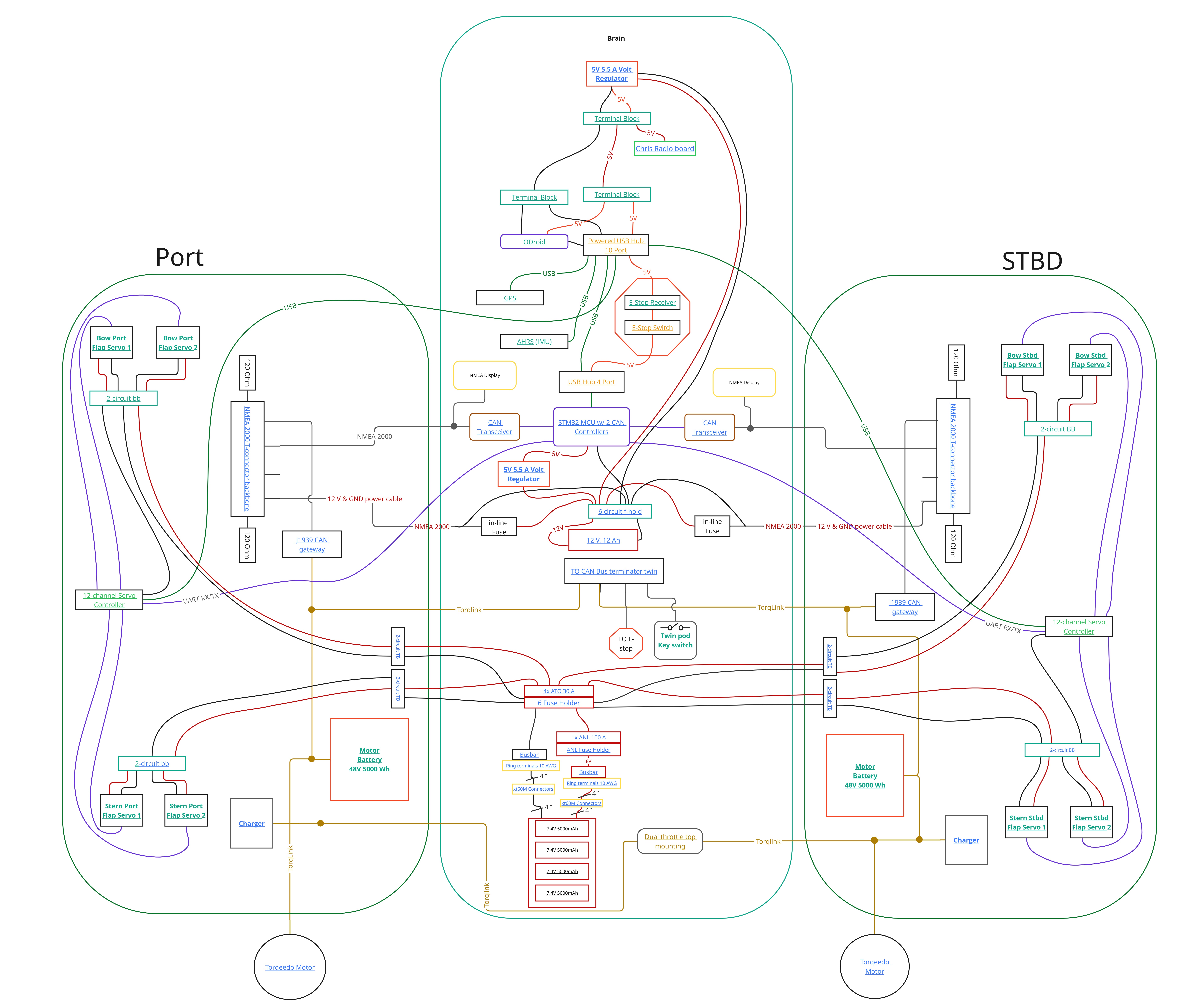
Autonomous Hydrofoil RHIB Platform

Robotics / Marine autonomy / Electrical architecture

Research Assistant, Center for Marine Autonomy & Robotics

Electrical and system architecture for an autonomous hydrofoil research boat integrating sensing, control, communication, and autonomy subsystems.

Why it mattered

Autonomous marine platforms need robust electrical and software architecture because they operate in noisy, uncertain, real-world environments where sensing, power, communication, and control must work together reliably.

Problem

The research platform needed a practical architecture for integrating motors, batteries, throttles, microcontrollers, sensors, communication protocols, sonar data, and autonomy software.

What I built

Led electrical and system architecture work for the autonomous hydrofoil RHIB. Selected motors, batteries, microcontrollers, throttles, and power components based on system requirements. Developed obstacle-avoidance logic and ROS drivers for sonar data parsing. Integrated sensing, communications, controls, and autonomy subsystems.

Technical depth

Worked with ROS, sonar data parsing, CAN communication, sensor integration, power systems, motor-control architecture, and field robotics constraints. The work required balancing electrical safety, autonomy goals, maintainability, and real-world reliability.

Impact

Helped move the autonomous RHIB research platform toward a more integrated and field-ready system architecture.

Skills demonstrated

Robotics systems integration, ROS development, sensor integration, architecture design, autonomy, embedded systems, marine robotics, communication protocols.

ROS ROS2 CAN Sonar Sensor Integration Marine Robotics Motor Control Power Systems Autonomy
4

Spurr

Full-stack platform / Community discovery / Product engineering

Founder & Lead Engineer

A full-stack platform helping people discover Christian communities, groups, ministries, and events in Greater Boston.

Why it mattered

Finding real community is often fragmented across Instagram pages, church websites, word of mouth, group chats, outdated calendars, and incomplete event listings. Spurr was built to make discovery easier, especially for young adults moving into a new city.

Problem

People looking for Christian community often do not know where to start, and organizations often lack a simple way to keep their information accurate, discoverable, and trustworthy.

What I built

Built and deployed a full-stack platform using Next.js, TypeScript, Supabase, PostgreSQL, and Vercel. Designed database models, authentication, ownership workflows, role-based access controls, public listings, admin workflows, verification systems, AI-assisted data ingestion, moderation, content management, analytics, email automation, and deployment workflows.

Technical depth

Designed the system to support many different data types: organizations, groups, events, users, claims, verification states, edits, and feedback. Built workflows for leaders to eventually claim and maintain their groups while allowing users to discover relevant communities through structured filters.

Impact

Aggregated 160+ organizations, groups, and events into a searchable platform for Greater Boston and built the foundation for scalable community discovery.

Skills demonstrated

Full-stack development, product design, database modeling, authentication, RBAC, AI-assisted ingestion, startup execution, UX thinking, stakeholder engagement.

Next.js TypeScript Supabase PostgreSQL Vercel RBAC Stripe Email Automation AI Ingestion Analytics
5

Electrical Design and AI Evaluation Work

Electrical design / AI evaluation / Circuit simulation

Electrical Design Engineer, AI Fellow

Electrical engineering and AI evaluation work focused on circuit design, simulation, technical reasoning, and training AI systems to produce better engineering outputs.

Why it mattered

AI systems need rigorous technical evaluation to become useful for real engineering work. This project/workstream focused on improving the quality, consistency, and correctness of AI-generated electrical engineering outputs.

Problem

AI tools often produce circuit-design answers that sound plausible but may be incomplete, poorly validated, or wrong. The challenge is to create evaluation frameworks and feedback that improve technical reliability.

What I built

Designed, simulated, and validated analog and digital circuits using KiCad, LibrePCB, Qucs-S, and Ngspice. Generated technical evaluations, prompt frameworks, documentation, and best practices for PCB design, circuit simulation, and EE reasoning. Reviewed technical deliverables and provided feedback on simulation methodology, troubleshooting, and design quality.

Technical depth

Worked across schematic design, circuit simulation, analog/digital reasoning, PCB design review, prompt engineering, and quality evaluation for AI-generated technical work.

Impact

Helped create more consistent workflows and evaluation standards for AI-assisted electrical engineering tasks.

Skills demonstrated

Circuit design, simulation, technical evaluation, documentation, prompt design, AI tooling, review quality, troubleshooting.

KiCad LibrePCB Qucs-S Ngspice PCB Design Circuit Simulation Technical Evaluation AI Reasoning

Full portfolio

Additional systems

These projects are smaller in scope but still show the same pattern: real hardware, constrained systems, and careful implementation.

6

Edge AI Low-Power Drone Detection System

Capstone Engineer | Edge AI / Embedded ML / Signal processing

A low-power edge AI system for detecting drones using real-time sensing and embedded processing.

Why it mattered: Drone detection often requires low-power, real-time processing at the edge, especially when cloud connectivity is limited or latency matters.

What I built: Developed the sensing and data processing pipeline and programmed a low-power real-time noise detection routine on a Raspberry Pi Zero 2W.

Impact: Created a working edge AI detection pipeline suitable for resource-constrained deployment.

Python Raspberry Pi Zero 2W Edge AI Signal Processing Embedded Linux Real-Time Detection
7

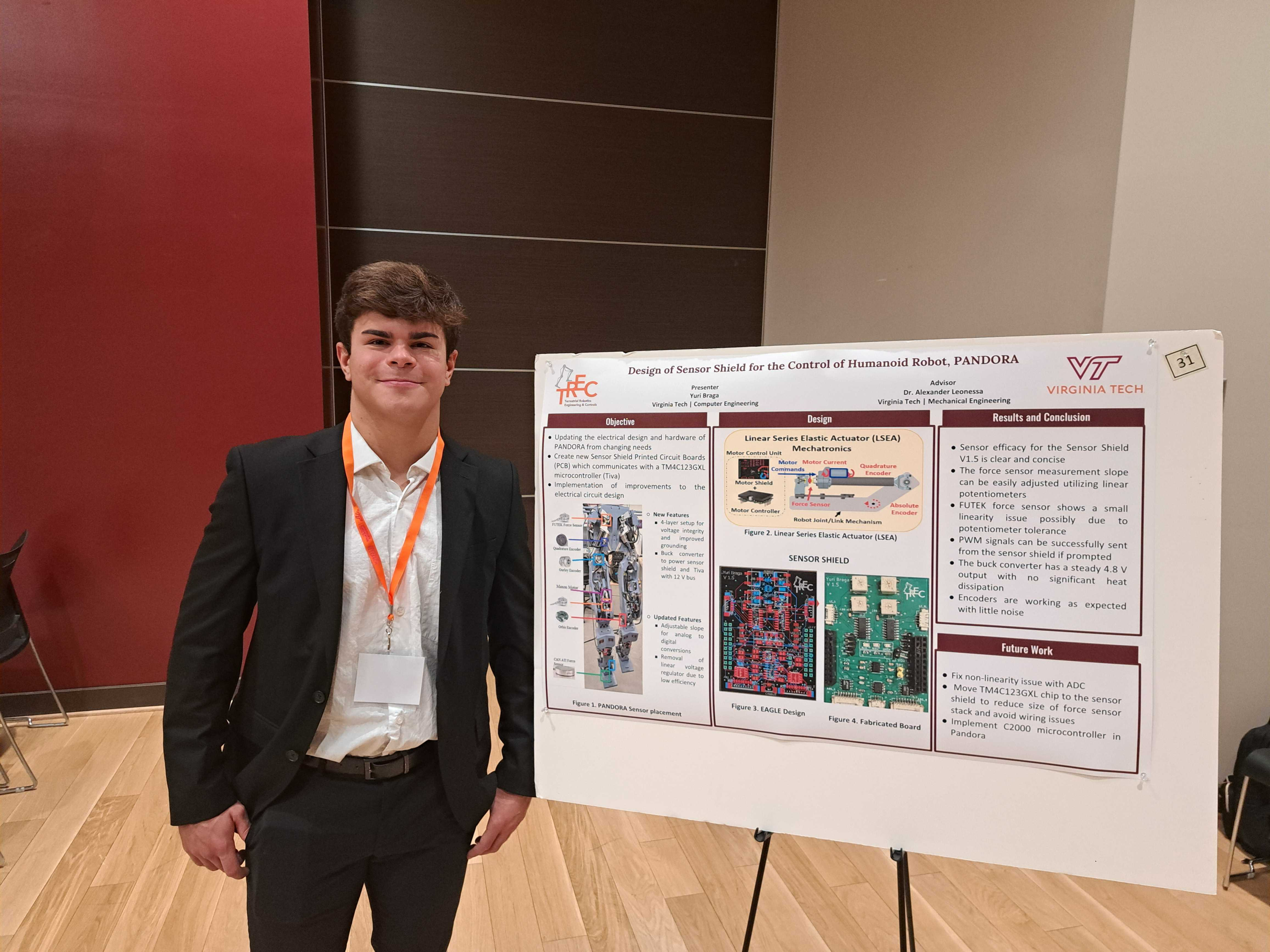
Humanoid Robot Pandora

Research Fellow | Robotics hardware / Firmware / Sensor systems

Hardware and firmware integration work for Pandora, a humanoid robotics research platform.

Why it mattered: Humanoid robots require reliable sensing, embedded hardware, and firmware infrastructure so higher-level control and robotics research can be tested safely.

What I built: Integrated sensing, PCB, and firmware systems for the humanoid robot platform. Worked on digital circuits, sensor shield PCB design, and firmware updates.

Impact: Supported robotics research infrastructure by improving the platform’s embedded and sensing systems.

C/C++ Firmware Sensors PCB Robotics Data Acquisition Embedded Systems
8

Infrared Radioteletype

Project Engineer | Circuits / Communication systems / Signal processing

A simple communication system using infrared light, analog filtering, and embedded control.

Why it mattered: The project demonstrated the full signal chain from optical transmission to analog filtering and digital interpretation.

What I built: Designed a radioteletype system using an IR LED, Arduino, photodiode, and cascaded Butterworth filtering.

Impact: Built a working communication system that connected circuit design, signal processing, and embedded implementation.

Arduino IR LED Photodiode Butterworth Filters Signal Processing Analog Circuits
9

Smart Home System

Project Engineer | Embedded systems / PCB / Edge computing

A PCB-based home system integrating Raspberry Pi GPIO, power breakout, NVMe/SSD support, and AI-oriented edge compute.

Problem: The system explored how to integrate edge compute hardware, storage, and GPIO expansion into a more compact smart-home architecture.

What I built: Designed a PCB to integrate power breakout, Raspberry Pi GPIO, and NVMe/SSD support for local AI and automation tasks.

Impact: A compact hardware concept that ties together embedded design and edge compute.

PCB Raspberry Pi GPIO NVMe Power Edge Compute

Technical themes

What these projects demonstrate

Across software, hardware, and research, the pattern is the same: build carefully, validate honestly, and ship systems that survive real use.

Production ML systems

CareFuse showed how to take an idea from feature engineering to calibrated, explainable deployment.

Experiment design and validation

From thermal test automation to clinical model validation, I focus on repeatable evidence.

Embedded firmware

I work comfortably in microcontrollers, sensors, state machines, and real-time constraints.

Robotics integration

CMAR and Pandora reflect systems thinking across autonomy, sensing, and field hardware.

Hardware bring-up and debugging

I enjoy the messy part: oscilloscopes, root cause analysis, and turning hardware into a dependable system.

Full-stack product development

Spurr combined product design, data modeling, access control, automation, and deployment into one platform.

Data pipelines and APIs

I like systems that make information useful, accessible, and safe to consume across teams.

Startup execution

CareFuse and Spurr both required customer discovery, prioritization, and the discipline to keep shipping.

Want the details behind one of these systems?

If you want a deeper look at architecture, tradeoffs, or what I learned building any of these projects, the resume and contact pages are the fastest places to start.